14.09.2026
A trail of technical developments suggests this unusual machine may be less about production and more about experimentation.
Thank you
I have always been drawn to motorcycles because, at their best, they are such a pure form of transport: an engine, just enough wheels not to fall over, and very little room to hide poor engineering. That is why this is such a fascinating time for the motorcycle industry.
For a few years now, it has felt as if motorcycles have been spoken about as if they belong to a declining corner of transportation. But from a technology perspective, the industry seems to be fighting back. That is part of what makes Kawasaki's hydrogen-powered Ninja H2 so interesting. The ‘Ninja’ brand has been part of Kawasaki’s heritage for decades, so it is fitting that it is now being associated with such a technology showcase.
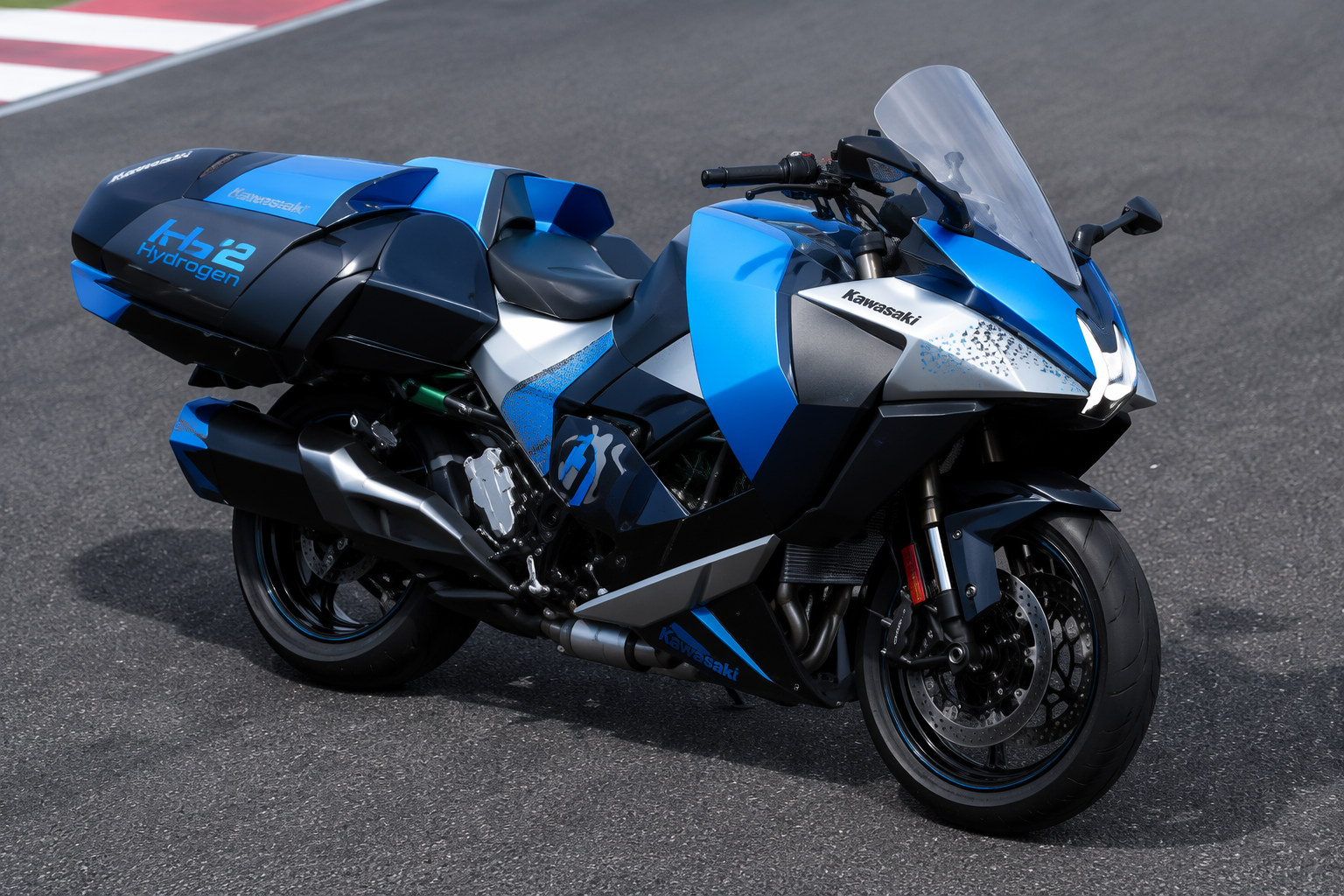
At first glance, it looks like a machine built to prove the sceptics right. It’s not the most handsome beast – the hydrogen tanks are bulky and will add plenty of mass, which is generally not desirable for a motorcycle, particularly when it is positioned up high, raising the centre of gravity. What’s more, a major compromise is that refuelling infrastructure is thin on the ground. Many riders will look at the concept and conclude, quite reasonably, that hydrogen motorcycles are not about to become mainstream. They might well be right, but that could be missing the point.
For me, the more interesting question is not whether Kawasaki's hydrogen-fuelled H2 ever reaches mass production, but whether the motorcycle is really a development platform; a way for Kawasaki to work through some of the hardest engineering problems associated with future propulsion systems.
The patents are what make that story more compelling. Viewed through Kawasaki's patent activity, the H2 looks less like a single future product and more like a rolling engineering exercise: energy storage, packaging, fuel delivery and system integration, all being tackled one problem at a time. That journey may be far more interesting than the motorcycle itself.
To understand Kawasaki's hydrogen programme, it helps to look at the platform that underpins it.
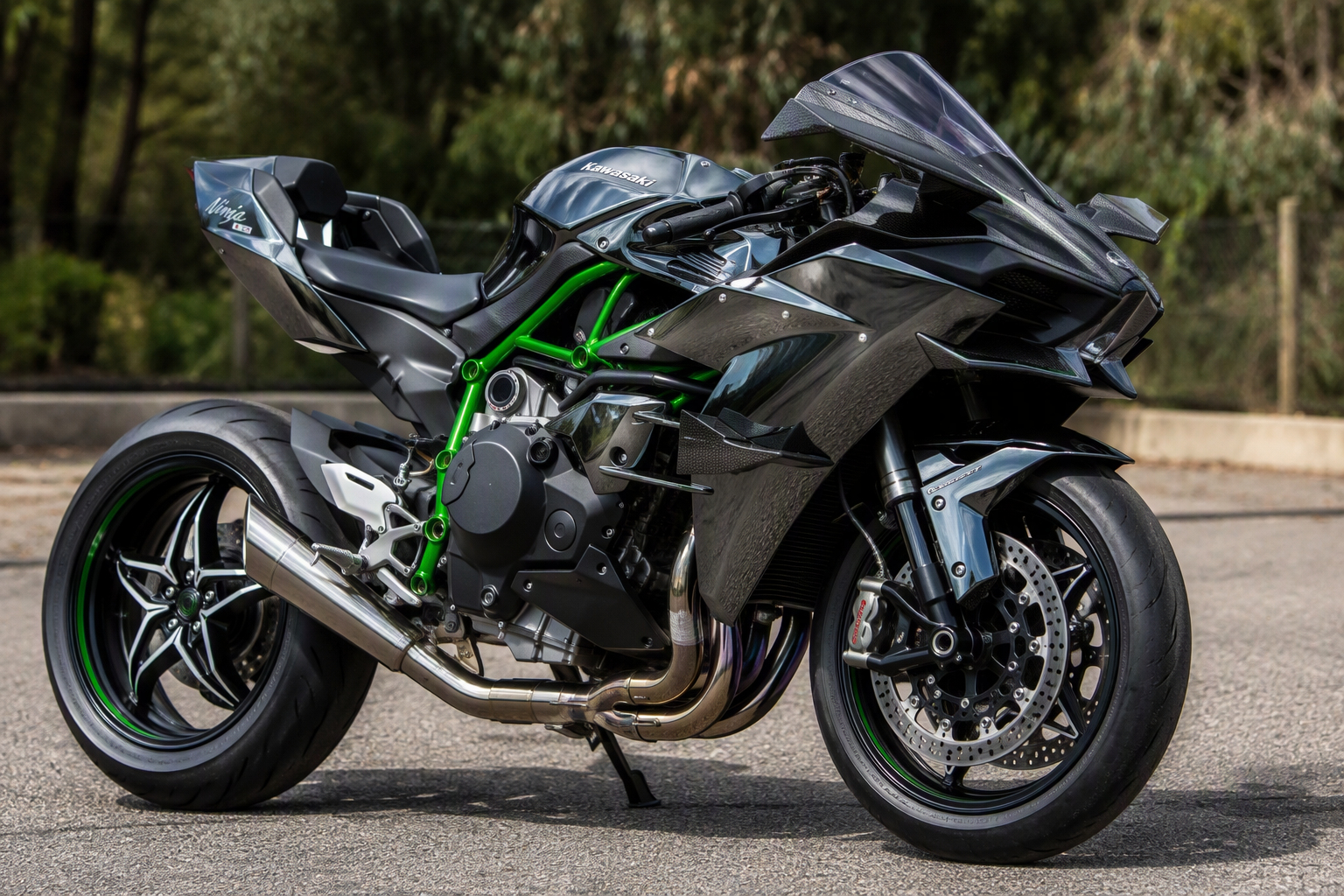
The Ninja H2 was never an ordinary motorcycle. When it was launched, Kawasaki developed its own supercharger technology and built a machine around it. While other manufacturers were refining conventional superbikes, Kawasaki created something that felt more like an engineering showcase than a traditional product. It’s impact was helped by its appearance in Top Gun: Maverick, of course.
That also fits with Kawasaki's wider identity. Kawasaki is not just a motorcycle manufacturer. Its engineering heritage reaches into aerospace, rail transport, robotics, industrial systems and energy infrastructure. It is exactly the sort of company you would expect to treat a motorcycle as a place to test ideas, rather than simply as a product category.
That broader perspective helps explain why the H2 platform has remained relevant for new technology development. Rather than treating the motorcycle as a finished destination, Kawasaki appears to have used the H2 as an evolving engineering laboratory. The hydrogen versions continue that approach. In that light, the additional tanks, unusual packaging and slightly odd-looking patents start to make more sense.
The fundamental challenge is not hydrogen. It is energy storage. Whatever the answer - batteries, hydrogen or something else - motorcycles are a brutal packaging exercise. A car gives engineers places to hide things. A motorcycle does not, as engineering compromises are often immediately apparent.
In many respects, motorcycles may be the ultimate proving ground for future propulsion technologies. If engineers can successfully package a new energy system into a motorcycle, they can probably package it almost anywhere.
This is where the patent story becomes particularly revealing.
When most people look at patents, they see possible future products. Patent attorneys and engineers tend to see something slightly different: a trail of technical problems that still need solving.
Viewed collectively, Kawasaki's hydrogen patents tell a story of incremental progress rather than a single grand reveal.
The journey begins with hydrogen combustion itself. Kawasaki demonstrated that an internal combustion engine derived from the H2 platform could be adapted to run on hydrogen. In doing so, it preserved much of the character that traditional motorcyclists value while removing conventional hydrocarbon fuel from the equation.
That achievement immediately created a new challenge - how do you carry enough hydrogen on a motorcycle?
Later patents and development concepts appear to focus on exactly that problem. Different tank layouts and storage arrangements suggest Kawasaki is exploring the practical limits of how much hydrogen can realistically be carried on a motorcycle without completely alienating its customer base.
The next question appears to have been whether compressed hydrogen is the best solution at all. More recent patent activity points towards liquid hydrogen concepts. The attraction is easy to understand. Liquid hydrogen offers the possibility of better energy density by volume, which matters enormously when every cubic centimetre is contested.
Of course, solving one problem simply creates another. Liquid hydrogen introduces additional complexity, particularly when it comes to moving fuel from the tank to the engine at the pressures required for efficient combustion.
WO2026053540A1 This is where Kawasaki's now-famous (in some parts…) "fake fifth cylinder" enters the story.
At first glance, the patent appears to show an extra cylinder attached to the familiar inline-four H2 engine. It looks slightly strange, which is probably why it caught people's attention. But the point is not another power cylinder. The additional piston arrangement appears to form part of a high-pressure pumping system for liquid hydrogen fuel delivery.
Whether this ultimately becomes a production solution is almost beside the point. The interesting thing about the patent is what it reveals. The invention is not trying to prove that hydrogen combustion can work, rather it is dealing with a more specific, downstream problem: how to make the fuel system practical once the basic idea has moved beyond the first feasibility question.
In other words, the patents don't reveal a future motorcycle, they reveal a development process.
One of the most revealing aspects of Kawasaki's hydrogen programme is that it is not happening in isolation.
Through the HySE (Hydrogen Small Mobility & Engine Technology) initiative, Kawasaki has joined with the other Japanese ‘big-four’ companies - Honda, Suzuki and Yamaha -in exploring hydrogen-powered engines for small mobility applications.
That does not mean hydrogen-powered motorcycles are inevitable, nor that Japanese manufacturers have decided that hydrogen will replace battery-electric vehicles. However, it does suggest that some of the world's most experienced motorcycle manufacturers believe the technology is worth understanding and progressing.
There is a tendency to talk about future mobility as a winner-takes-all contest: electric versus hydrogen, batteries versus combustion, one future succeeding while the others disappear. However, engineering organisations rarely think this way. Successful engineering companies often invest in several pathways at once. They build expertise, generate knowledge and preserve strategic flexibility while the future is still uncertain.
Viewed through that lens, Kawasaki's hydrogen programme looks less like a bet on a single outcome and more like a programme of structured exploration.
The patents support that interpretation. Collectively, they read less like the specification for a future showroom model and more like engineers probing the limits of what is technically possible. And perhaps that is exactly the point. The objective may not be to predict the future, but to be ready for several possible futures at once.
So, will Kawasaki's hydrogen-powered Ninja H2 ever become a mainstream production motorcycle? Not wanting to sound like a major sceptic, I, personally, can’t see it. However, what I think doesn’t matter. The patent trail suggests that Kawasaki is using the H2 to tackle some of the hardest challenges in future mobility: energy storage, packaging, fuel delivery and system integration. Each patent represents another step in understanding how alternative propulsion technologies might work when applied to one of the most demanding vehicle platforms imaginable.
Whether the future ultimately belongs to hydrogen, batteries or something else entirely remains uncertain. What is certain is that someone has to do the difficult engineering work to find out and, looking at Kawasaki's patents, that appears to be exactly what Kawasaki is doing. If nothing else, it is an exciting time for motorcycle engineering.
Thank you